SEED Sprouts: Inside the Ambitious, Social Experiment MMO Now Launching After Near 10 Years of Development
Something of a multiplayer Civilization meets The Sims, every object and character ages in real time, even when you’re logged out.

This week, the utopian world of Avesta was wiped out, dissolving whole cities and societies forever in the process. “All of that is going to come crashing down,” the planet’s god admitted to me recently.
Not to worry, though, it’s being reborn next week. July 21, to be exact.
Avesta of course is the setting for SEED, a wildly ambitious MMO that’s been in development for nearly 10 years.
A single-shard, fully persistent virtual world, SEED might be described as multiplayer Civilization meets The Sims, where players control one or more of the planet’s inhabitants (Seedlings) and their daily lifecycles -- while also getting to organize with other players and form new government systems with them. It’s so ambitious that very early on, Harvard constitutional scholar Larry Lessig* helped advise SEED’s developers (Klang Games) on designing the governance options (as reported back then):
Lessig was approached by Klang on the morning after President Trump’s [2016] election. He sees Seed as a powerful tool for demonstrating the role of governance and the critical importance of civic engagement. “We’ve got real challenges with democracy in the real world. At least in my country, it’s not working well, if at all,“ says Lessig. “So, what was really intriguing to me was the idea that we could create an environment where there could be many tens of thousands of experiments with different forms of governance.
Now, at last, that experiment is launching this month in Early Access.
Can Seed fulfill those ambitions, or least succeed as a fun and quirky MMO? To find out, I reconnected with Klang CEO Mundi Vondi (the aforementioned god above) for a chat as he strolled the streets of Berlin.
By way of full disclosure, I did some editorial writing for Seed/Klang back in 2019 (call it pre-embedded journalism), but haven’t followed the project closely since. The vision, Mundi tells me, has basically remained the same; the challenge has been to balance the scaling / back-end challenges, and the gameplay.
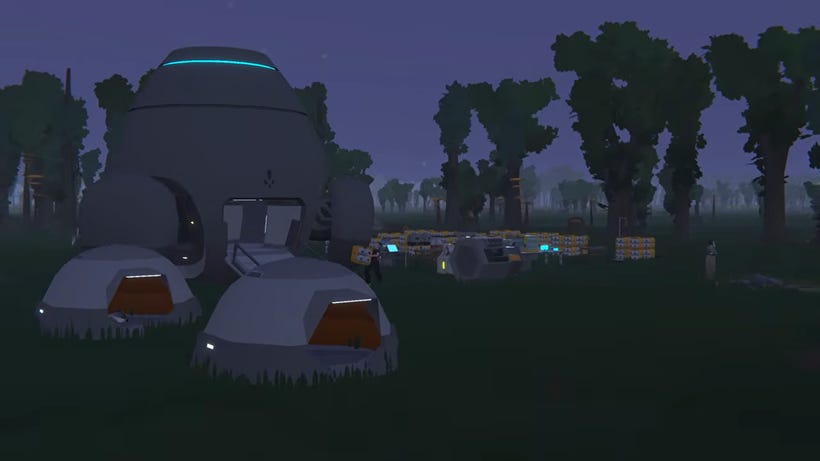
Players begin with a tent, claim a plot on the bare planet, and start forming communities with nearby players. In closed beta player tests with up to 200 players, for example, early iterations of Seed were more about survival gameplay “which got too militaristic” Mundi says.
“It’s really fun with a small community,” says Mundi. “We’ve come to realize how much that direction would grow.” Seedings even have their own in-game social network to chat and flirt with each other.
Players control a floating orb that flies around the planet, enabling them to jump between their Seedling characters, either controlling them directly or setting them up to run autonomously. Players start with one Seedling slots (if you buy the game before the 21st, you get two), from which you can add more slots after accomplishing various Seedling goals, and grow your Seedlings into a family.
The planet of Avesta is single shard, divided into islands of up to 3000 Seedlings, where societies can emerge. “These societies need to build out infrastructure to grow users.” Otherwise, there’s a struggle for food which may wipe out that island.
And it is indeed persistent, Mundi tells me, with every object and Seedling decaying and aging in real time, even when you’re logged out. “That feeling is really special when you come back the next day -- it starts to feel like a virtual living.” (Klang will later add a mobile app, so players can keep in touch with their Seedlings while, say, on vacation with their actual family.)
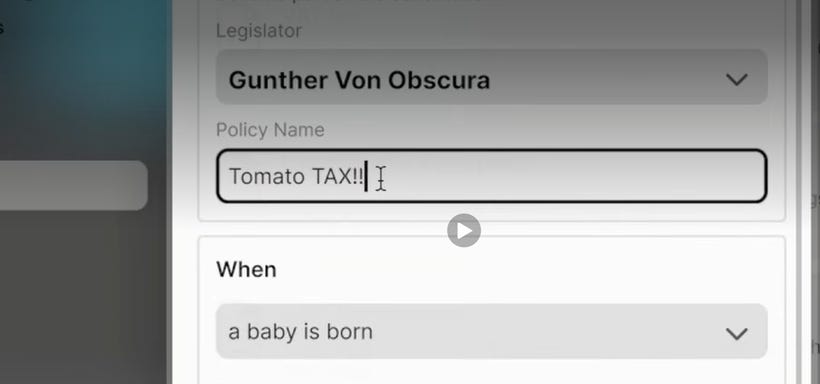
Above: Laying down the law for a SEED subcommunity (from the gameplay trailer)
And yes, societies can create taxes, ownership rules, and form governments which can even claim assets from other players. (”That’s what governments can do in reality, they can screw you over.”) Seedlings can be killed too, of course. “It’s not that I want to incite violence,” Mundi notes, “but [the game] has to come with the negative elements as well”.
Mundi Vondi is fascinated to see different kinds of societies emerge throughout each playthrough, “and you get to experience another life and be part of an ever-evolving society”. At one point, for instance, some closed beta users chose for themselves… a dictatorship.
Overall, though, “I’ve seen societies be surprisingly collaborative.” Griefers do show up, as in all virtual worlds, but Klang is working on solutions other than just banning them.
“Banning is too digital”, as Mundi explains, so the developers are planning to deal with griefers via an in-game law enforcement and court system.
Now the question is how many new players will join SEED beyond the hundreds who’ve enjoyed it in closed beta.
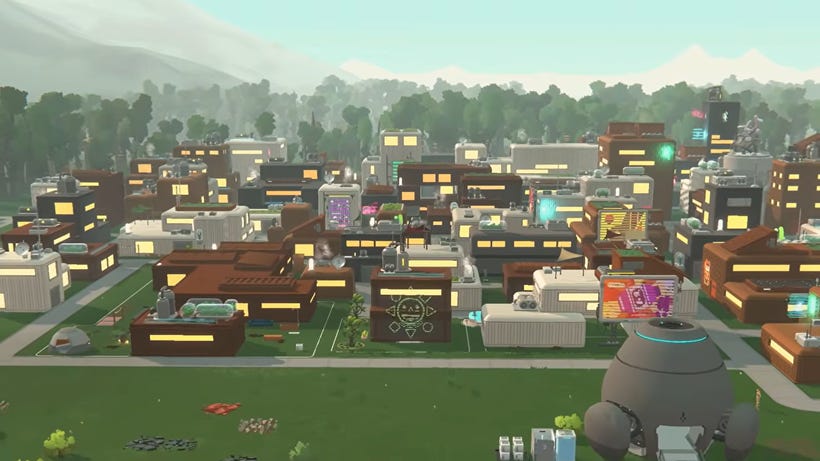
Including, Mundi mentions, chuckling, himself: His own Seedling had a daughter who became a heiress to a hotel he had bought, which ended up making decent money, which then made it difficult for him to leave the city, even when the population started to emigrate to other parts of Avesta.
“That just blew me away,” Mundi Vondi tells me. “I was sort of falling into my own narrative there.”
Here’s the SEED site, and here’s the official Discord server -- where, Mundi adds, planetary political rivalries are already blowing up.
* Lessig, as longtime readers may remember, also helped advise Linden Lab early on around player IP rights and UGC created in Second Life.